Structured data in the AI search era: what still matters for a SaaS or tool site
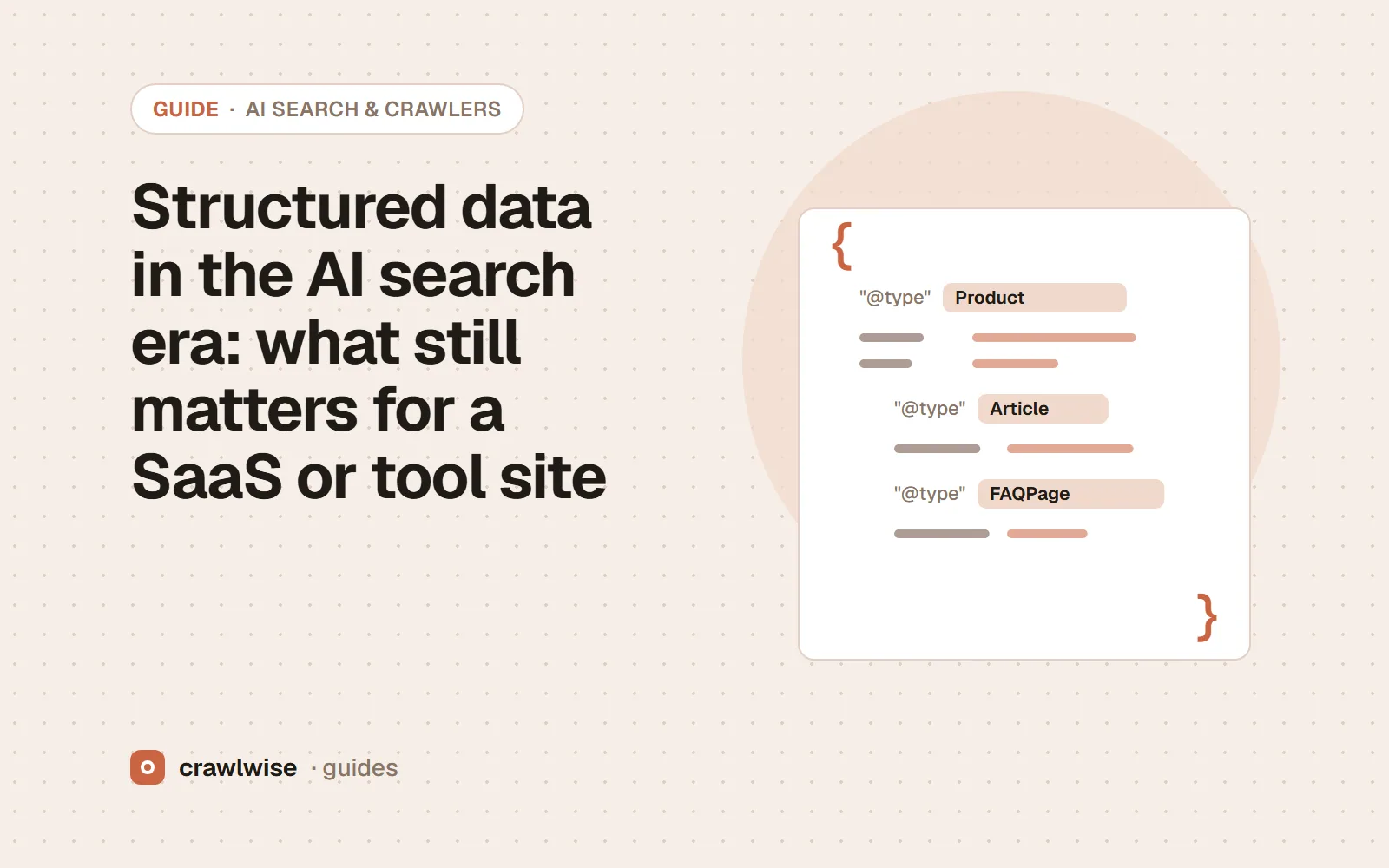
Structured data still helps search engines understand a page and can make it eligible for some rich results, but it guarantees neither a rich result nor an AI citation. Google says generative search needs no special schema. For a SaaS or tool site, accurate Organization, WebSite, BreadcrumbList, Article and SoftwareApplication markup is still worth keeping.
Key takeaways
- Structured data is a hint for understanding, not a guarantee of any display.
- Google: no special schema is needed for AI Overviews or AI Mode.
- FAQ rich results stopped showing on May 7, 2026; several other types were retired in 2025.
- Markup must match what a visitor can see on the page.
Two opposite myths circulate: that schema is now the key to AI citations, and that schema is dead because Google retired several rich results. Google’s documentation supports neither. Structured data is what it always was — explicit clues about what a page is — and its visible payoffs have narrowed.
What does structured data still do?
Google: “You can help us by providing explicit clues about the meaning of a page to Google by including structured data on the page.” It can make a page eligible for rich results when required properties are present and guidelines are followed, but eligibility is not a guarantee. Google recommends JSON-LD where your setup allows.
Does structured data help with AI search?
For Google, there is a direct answer: “Structured data isn’t required for generative AI search, and there’s no special schema.org markup you need to add.” Google adds that it remains useful for your wider SEO and for rich results. For other AI engines, we found no vendor documentation naming schema.org as an input to citations. It may help a system understand a page, as it helps Google; that is different from being a lever you can pull.
Schema describes the page you already have. If the page does not answer the question, no markup will make it.
Adnan Arodiya, Crawlwise
Which rich results has Google retired?
Google’s documentation log records that FAQ rich results stopped appearing in Google Search from May 7, 2026, and the documentation was removed on June 15, 2026. Practice problem markup was retired in January 2026, and in September 2025 Google removed documentation for course info, estimated salary, learning video, special announcement and vehicle listing results after a June 2025 simplification. The vocabulary still exists on schema.org; the Google display does not.
Which types still matter for a SaaS or tool site?
| Type | Why keep it | Watch out for |
|---|---|---|
| Organization | Name, logo, URL and official profiles in one place | Keep it consistent with your about and contact pages |
| WebSite | Helps Google pick your site name | One per site, on the homepage |
| BreadcrumbList | Breadcrumb display and site structure | Must match the visible breadcrumb |
| Article / BlogPosting | Headline, author, published and updated dates | Dates must match the visible dates |
| SoftwareApplication | Describes the product, category and price | Ratings only if they are genuine and shown on the page |
{
  "@context": "https://schema.org",
  "@type": "SoftwareApplication",
  "name": "Example Invoicing",
  "applicationCategory": "BusinessApplication",
  "operatingSystem": "Web",
  "offers": { "@type": "Offer", "price": "9.00", "priceCurrency": "USD" }
}
Skip anything you cannot keep true. Markup that disagrees with the visible page is against Google’s guidelines and does more harm than no markup.
What should you do instead of chasing schema for AI?
Make sure the crawlers that feed AI answers can read the page at all, and that the answer is in the HTML. Our AI Crawler Access Report does not measure structured data; it measures access, and in the Crawlwise AI Crawler Access Report (top-10000 run, 2026-Q4: the first 10,000 domains of the Cisco Umbrella top-one-million list, each probed once on October 1, 2026), 4,159 of 10,000 domains refused at least one AI crawler. The list ranks hostnames by DNS popularity, so it includes API, CDN and update hosts that never serve a web page, and only the homepage path was probed. Treat the shares as a description of that list, not of the whole web. Start with checking AI crawler access, then what you can control in AI Overviews.
How Crawlwise tests this
The schema validator reads the JSON-LD in your source HTML and reports each block as eligible, ineligible or not applicable against the Google feature requirements we have recorded. It does not parse Microdata or RDFa, and eligibility is never a promise of a rich result. To write markup from scratch, use the schema generator.
Every verdict, what counts as a block, and what the checks cannot see are written up on the methodology page.
What a plan actually costs
The free tools stay free. You can open them, run them, and leave without an account. A plan is for the moment you want the report saved, a few sites watched, or the same checks from the API. The price on this table is the price at checkout. A yearly plan is ten months of the monthly price, so two months are on us.
| Plan | Monthly | Credits | A good fit when |
|---|---|---|---|
| Starter | $4.99 | 10 | You look after one site and check it now and then |
| Pro | $14.99 | 40 | A few sites, plus the API and a handful of watched URLs |
| Studio | $49.99 | 150 | Client work that would burn through Pro mid-month |
| Agency | $99.99 | 400 | Many locations, reported under your own name |
A single-page audit is about 1.25 credits, and that includes the live probe of answer-engine crawlers. You see the estimate before anything runs. If a hold is not used, it comes back to your balance. Extra credits, when you already subscribe, are $9.99 for 20.
Frequently asked questions
Should I remove FAQPage markup now that FAQ rich results are gone?
You do not have to. Google stopped showing FAQ rich results from May 7, 2026; markup left in place is simply not used for that feature. Remove it if it no longer matches visible content.
Does structured data make ChatGPT or Perplexity cite me?
No vendor documents that. OpenAI, Anthropic and Perplexity crawler docs do not mention schema.org as a citation signal, so treat any claim that it does as unproven.
JSON-LD, Microdata or RDFa?
Google accepts all three and recommends JSON-LD where your setup allows, because it is easiest to implement and maintain.
Sources
Vendor documentation was read on 2026-10-05. Vendors change these pages without notice, so check the original before you act on a detail.
- Google Search Central — Introduction to structured data markup
- Google Search Central — AI optimization guide
- Google Search Central — AI features and your website
- Google Search Central — Latest documentation updates (FAQ rich result removal)
- OpenAI — Overview of OpenAI crawlers
- Anthropic — Does Anthropic crawl data from the web, and how can site owners block the crawler?
- Perplexity — Perplexity crawlers
- Crawlwise — The AI Crawler Access Report (top-10000 run, 2026-Q4)
Crawlwise vs a typical SEO suite
Price to start
- Crawlwise
- Free tools, plans from $4.99
- Typical suite
- $139+ typical suite
What you see
- Crawlwise
- The check, the value, the limit
- Typical suite
- Often a score
Answer-engine crawlers
- Crawlwise
- Fetched live, per bot
- Typical suite
- Rarely tested
Backlink index
- Crawlwise
- Not what we built
- Typical suite
- A core product
Whole-site desktop crawl
- Crawlwise
- Bounded pages on a plan
- Typical suite
- Often the whole catalogue
Meet the author

Adnan Arodiya
Crawlwise
Writes about what Crawlwise actually measures: on-page evidence, crawler access, and performance signals — with the limits stated up front.