XML sitemaps: lastmod honesty, size limits, and what Google ignores
An XML sitemap should list only canonical, indexable URLs as absolute addresses, at most 50,000 URLs or 50MB uncompressed per file. Google ignores priority and changefreq, and uses lastmod only when it is consistently and verifiably accurate. Stamping today’s date on every URL teaches search engines to ignore your dates. A sitemap is a hint, not an indexing request.
Key takeaways
- Limits: 50,000 URLs and 50MB uncompressed per sitemap; use a sitemap index beyond that.
- Google ignores <priority> and <changefreq>.
- lastmod should be the date the page content changed, not the date the file was built.
- The Google sitemaps ping endpoint is gone; use Search Console and robots.txt.
Sitemaps are one of the few SEO files that search engines document precisely, and one of the most commonly padded with fields they say they ignore. A good sitemap is short on decoration and long on accuracy.
What are the size limits for an XML sitemap?
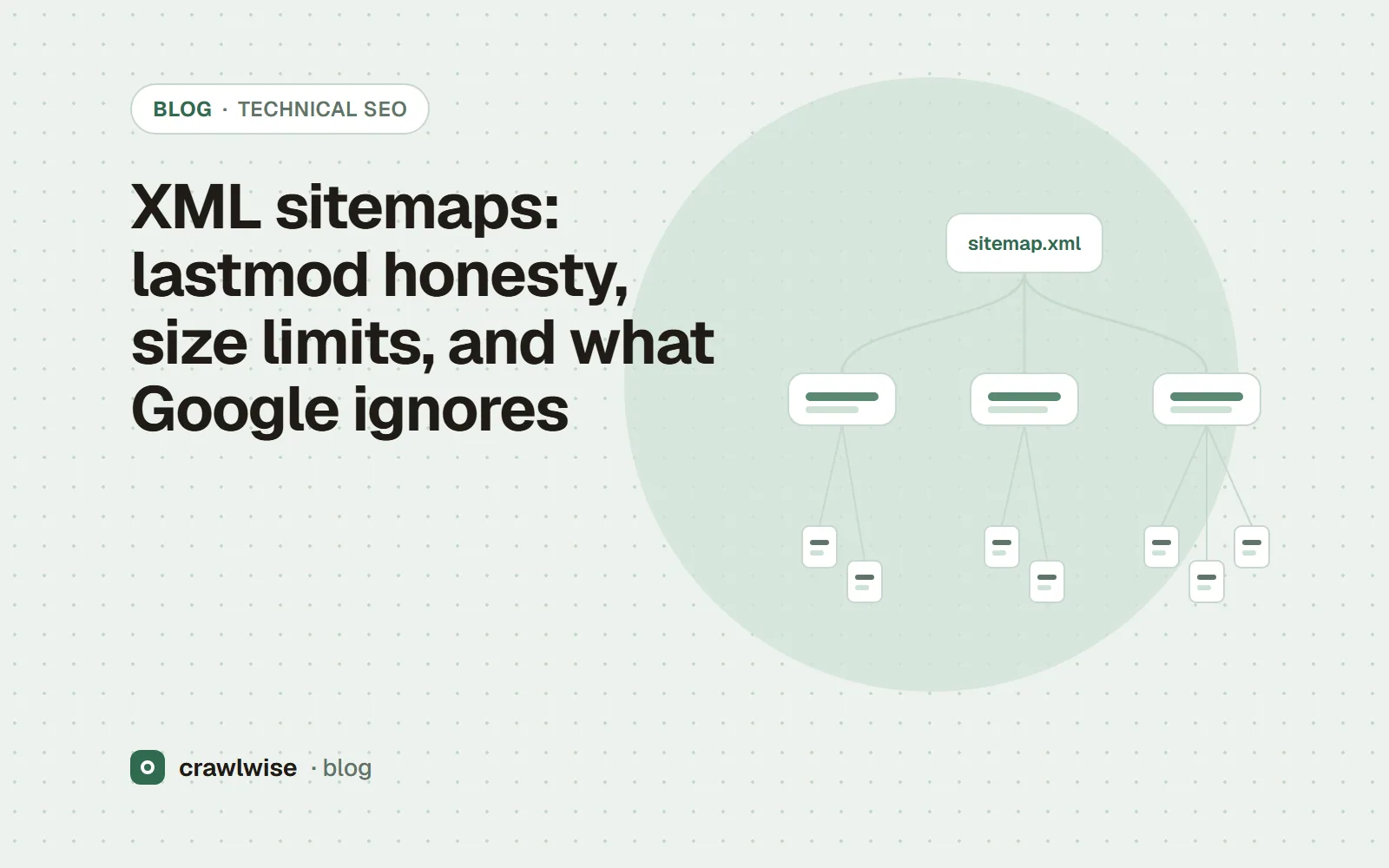
Google: “All formats limit a single sitemap to 50MB (uncompressed) or 50,000 URLs.” The sitemaps.org protocol gives the same numbers — 50,000 URLs and 52,428,800 bytes — and the same limits for a sitemap index, which may list up to 50,000 sitemaps. The file must be UTF-8. All URLs in a sitemap must be from a single host, and Google asks for “fully-qualified, absolute URLs”, because it “will attempt to crawl your URLs exactly as listed.”
<?xml version="1.0" encoding="UTF-8"?>
<sitemapindex xmlns="http://www.sitemaps.org/schemas/sitemap/0.9">
  <sitemap>
    <loc>https://example.com/sitemaps/products-1.xml</loc>
    <lastmod>2026-10-02</lastmod>
  </sitemap>
  <sitemap>
    <loc>https://example.com/sitemaps/blog.xml</loc>
    <lastmod>2026-10-05</lastmod>
  </sitemap>
</sitemapindex>
Does Google use priority and changefreq?
No. The sentence in Google’s documentation is short: “Google ignores <priority> and <changefreq> values.” The protocol itself always called them hints, “not a command”. Leaving them out makes the file smaller and removes a field that is easy to get wrong.
How does Google use lastmod?
Google “uses the <lastmod> value if it's consistently and verifiably (for example by comparing to the last modification of the page) accurate.” The change should be significant — the main content, structured data or links, not a footer year. When Google retired the sitemaps ping in 2023 it was blunter: “if your page changed 7 years ago, but you're telling us in the lastmod element that it changed yesterday, eventually we're not going to believe you anymore”. You may use lastmod “for all the pages in your sitemap, or just the ones you're confident about.”
Bing says the same from the other side: “the date must be set to the date the linked page was last modified, not when the sitemap is generated.” Use the W3C date format, either 2026-10-05 or a full timestamp with a time zone.
A lastmod that changes every night is a lastmod nobody reads. Put the date the content changed, or put nothing.
Adnan Arodiya, Crawlwise
Which URLs belong in a sitemap?
- Only canonical URLs. A sitemap entry is a weak canonical signal; listing a duplicate argues with your own tags (see canonical tags).
- Only URLs that answer 200. Listing 404s and redirects wastes crawl requests; see HTTP status codes for SEO and redirect chains.
- Only indexable URLs — no noindex pages, nothing blocked by robots.txt.
How do search engines find your sitemap now?
Google deprecated the sitemaps ping endpoint in June 2023; it says requests to it now return a 404. Submit sitemaps in Search Console, and list them in robots.txt with a Sitemap: line so every crawler can find them. Even then, “submitting a sitemap is merely a hint: it doesn't guarantee that Google will download the sitemap or use the sitemap for crawling URLs on the site.”
How Crawlwise checks this
The free XML sitemap generator builds a urlset in your browser from a list of absolute URLs on one origin, up to 50,000. It rejects fragments and invalid dates, and writes lastmod, changefreq and priority only when you fill them in — it never stamps today’s date for you. The sitemap validator fetches a sitemap or sitemap index (files up to 4 MB), checks that it is a urlset or sitemap index and not an HTML page, and flags missing <loc> entries, duplicates, relative URLs, unreadable lastmod dates and more than 50,000 URLs. It then requests the first 10 listed URLs and shows their status codes. It does not check every URL, does not open the child sitemaps of an index, and cannot tell whether a listed page is canonical or noindex, or whether your dates are honest.
What each check reads, what counts as a failure, and what the checks cannot see are written up on the methodology page.
What a plan actually costs
The free tools stay free. You can open them, run them, and leave without an account. A plan is for the moment you want the report saved, a few sites watched, or the same checks from the API. The price on this table is the price at checkout. A yearly plan is ten months of the monthly price, so two months are on us.
| Plan | Monthly | Credits | A good fit when |
|---|---|---|---|
| Starter | $4.99 | 10 | You look after one site and check it now and then |
| Pro | $14.99 | 40 | A few sites, plus the API and a handful of watched URLs |
| Studio | $49.99 | 150 | Client work that would burn through Pro mid-month |
| Agency | $99.99 | 400 | Many locations, reported under your own name |
A single-page audit is about 1.25 credits, and that includes the live probe of answer-engine crawlers. You see the estimate before anything runs. If a hold is not used, it comes back to your balance. Extra credits, when you already subscribe, are $9.99 for 20.
Frequently asked questions
Should I set lastmod to today on every URL?
No. Google uses lastmod only when it is consistently and verifiably accurate, and Bing says it must be the date the page was last modified, not when the sitemap was generated. Leave it out for URLs you are unsure about.
Can I still ping Google with my sitemap?
No. Google deprecated the sitemaps ping endpoint in June 2023; requests to it return a 404. Submit through Search Console and list the sitemap in robots.txt.
Does a sitemap get my pages indexed?
Not by itself. Google calls submitting a sitemap “merely a hint” that does not guarantee the sitemap is downloaded or used. It helps discovery; indexing depends on the pages.
Sources
Documentation was read on 2026-10-05. Search engines change these pages without notice, so check the original before you act on a detail.
- Google Search Central — Build and submit a sitemap
- Google Search Central Blog — Sitemaps ping endpoint is going away (June 2023)
- sitemaps.org — Sitemaps XML format
- Bing Webmaster Blog — The Importance of Setting the lastmod Tag in Your Sitemap (February 2023)
- Google Search Central — How to specify a canonical URL with rel="canonical" and other methods
Crawlwise sitemap tools vs checking by hand
Checks file type, duplicates and non-absolute URLs
- Crawlwise
- Yes
- By hand
- A script you write
Flags lastmod values a parser cannot read
- Crawlwise
- Yes
- By hand
- Rarely checked
Checks where listed URLs land
- Crawlwise
- First 10 URLs only
- By hand
- Every URL, if you script it
Knows whether your lastmod dates are true
- Crawlwise
- No — only you know when content changed
- By hand
- No
Meet the author

Adnan Arodiya
Crawlwise
Writes about what Crawlwise actually measures: on-page evidence, crawler access, and performance signals — with the limits stated up front.